
When a Survey Turns Neighbors Into Opponents

For years, neighbors may live peacefully side by side. Their children grow up together. They borrow tools, share keys, attend backyard gatherings, and treat a row of trees, a driveway, or a fence as the practical boundary between their properties. Then one owner decides to install a deck, pool, fence, or addition and orders a survey.

In many cases, that survey does more than mark a line. It starts a conflict. A piece of ground that everyone treated one way for decades is suddenly described another way on paper. What had been a neighborly understanding can quickly become a lawsuit.

Our firm has handled these disputes both in court and through mediation. We have tried boundary and adverse possession cases and have also worked with neighbors to resolve disputes before the cost, stress, and damage to relationships become unnecessary. The purpose of this post is to explain what commonly happens, what the law generally considers, and why these issues are often best addressed early, carefully, and with the help of counsel who understands this specific area of property law.

Common Boundary Dispute Scenarios

Although every property dispute depends on its own facts, two recurring patterns appear again and again.

  1. The older urban property. In many older neighborhoods, homes were built decades ago based on subdivision plans, stakes, driveways, garages, and practical use rather than today’s more precise surveying methods. A driveway may have been used for generations, only for a new survey to suggest that several inches of it fall across the deeded line. Suddenly, a neighbor may claim the right to block access to a garage or prevent ordinary use of land that has been treated the same way for 50, 75, or even 100 years.
  2. The suburban property. In many suburban developments built in the 1960s and 1970s, original markers may have been moved, rows of trees may have been planted, and owners may have mowed, gardened, maintained sheds, or used driveways according to visible boundaries rather than deed descriptions. Years later, a new owner orders a survey before installing a fence and discovers that the record line may cut through what the neighbors have long treated as their yard.

The Law Is About More Than the Survey

A survey is important, but it is not always the final answer. In Pennsylvania boundary disputes, courts may also consider how the land was actually used over time. Several legal doctrines can affect whether the deeded line controls, whether ownership has changed, or whether one neighbor has acquired a right to continue using part of the property.

  1. Adverse possession. In general terms, adverse possession may apply when someone has possessed land in a way that is actual, continuous, exclusive, visible, notorious, and hostile for the required period of time (21 years). In Pennsylvania, “hostile” does not mean angry or malicious. It generally means the possession was under a claim of right and without the true owner’s permission.
  2. Boundary by consent. Boundary by consent can arise when neighbors have long recognized and accepted a practical boundary, or when they resolve a disputed boundary by agreement. In some circumstances, the conduct of prior owners may also matter.
  3. Prescriptive easement. A prescriptive easement may become important when the persons who have been using the land cannot prove they have possessed it exclusively.

What People Often Do Wrong

When emotions take over, property owners often make one of two mistakes. Some immediately hire a lawyer and prepare for war with a person who was recently a friendly neighbor. Others try self-help: installing a fence, cutting trees, removing landscaping, blocking access, or otherwise taking physical control of the disputed area without a court order.

Self-help can be especially dangerous. It may put the property owner on the wrong side of the case from the beginning and, in serious cases, may expose that owner to claims for damages, including punitive damages. Even when litigation is necessary, it should be approached with a clear understanding of the law, the facts, the evidence, and the practical cost of fighting.

The Cost of Getting It Wrong

Boundary disputes can become expensive very quickly. If the party using the disputed area can prove the necessary elements through photographs, family testimony, neighbor testimony, prior-owner testimony, and years of consistent use, the court may decide the case based on those facts rather than the newly obtained survey alone. By the time the dispute reaches trial, both sides may have spent tens of thousands of dollars, damaged a neighborly relationship, and still ended up with a result that could have been addressed more efficiently at the beginning.

A Better Approach

Talk Before the Conflict Hardens

The first step is often a careful conversation. The focus should not simply be “what does the survey say?” but “what has actually happened on the ground, for how long, and what evidence supports each side’s position?” Before having that discussion, it is often wise to speak with a lawyer who understands boundary disputes, because certain statements or offers can unintentionally affect important legal issues.

Use Mediation When the Relationship Matters

Mediation can be particularly valuable in these cases. A mediator who understands adverse possession, boundary by consent, prescriptive easements, deeds, surveys, and courtroom risk can help both sides evaluate the dispute realistically. Mediation is not arbitration. The mediator does not decide who wins. Instead, the mediator helps the parties find a practical resolution that may include a boundary agreement, an easement, a deed, shared costs, restoration work, or other terms that solve the legal problem while preserving as much of the neighborly relationship as possible.

Experience Matters

These disputes require both litigation judgment and settlement judgment. As litigators, we understand what evidence must be developed, how these claims are tried, and what risks each side faces in court. As mediators, we also understand that many boundary disputes are better resolved before they consume the parties’ time, money, and peace of mind. The right approach depends on the facts, the law, and the people involved.

If a survey has raised a question about your property line, driveway, fence, trees, yard, or use of land, it is important to get advice before taking action. A careful review at the outset may prevent an avoidable lawsuit and may help protect both your property rights and your relationship with your neighbor.
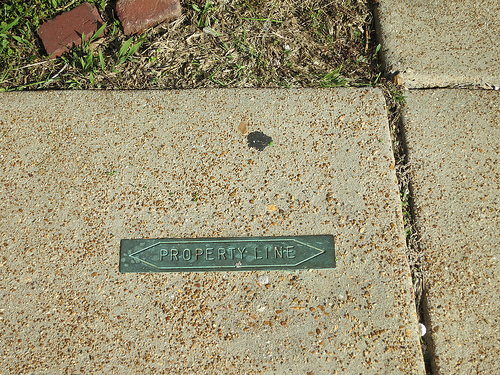
What the Heck is Tacking?

We just successfully finished an interesting trial on the subject of Tacking.  Our client lost patience with his next door neighbor.  About 20 years ago the daughter of the longtime neighbor moved in and doubled the size of the home and expanded her use of a driveway onto my clients property. Things got worse in about 2013 where the next door neighbor’s new husband built a large concrete  architectural deck on out client’s property and installed electric and large tent structures.

There was a large dispute over permission or lack of permission to use the area but the interesting topic was tacking.  Remember the neighbor’s daughter had been using the property for 20 years.  The original neighbor (the mother) died in about 2013.  Her estate was probated but no deed ever issued to the current occupant.   The neighbor wanted to “tack” her mothers period of ownership to her period of occupancy to get past the 21 years needed for adverse possession.

At the beginning of trial in front of a visiting judge, we handed up a “Pocket Brief” on the subject of tacking.  The judge recessed to read the brief and came back to tell Defendant (the neighbor) she had no case as a matter of  law.  Since this was a “knockout” in the first seconds of the first round, we thought a copy of the brief would be useful for people trying to learn about tacking.

                                                                  MEMO OF LAW

Defendant in this matter has not occupied the property she claims by adverse possession for the required 21 years. The property to which she claims a fee simple ownership is adjacent to property where she lives. She is not a record owner of that property. Record title is in her deceased mother, whose estate has been probated and closed.

Defendant claims her mother occupied the claimed area by actual, continuous, exclusive, visible, notorious, distinct and hostile possession of the subject property for a number of years. She claims the right to add this time to her time of possession to make up the 21 years under the concept of tacking.

The Supreme Court has made it clear that in cases of adverse possession tacking requires privity of title. See Baylor v, Soska, 658 A. 2d 743 (PA 1995) citing Masters v. Local Union No. 472 United Mine Workers, 22 A.2d 70(Pa. Super 1941). The Baylor Court described privity as a succession of relationship to the same thing. It discussed that succession as coming out of a deed, or other acts or by operation of law.

This concept of privity requires two types of analysis; 1) is there a deed, other act or some operation of law in play; and 2) if one or more of those concepts exists, does it create privity.

The most common application of this principle is where successive owners to a property wish to add together, or tack, their adverse occupancy of a certain parcel of land. The Baylor Court made it clear the deed alone does not create privity to anything outside the metes and bounds described in the deed. In more simplistic terms, for taking to apply the deed must not only describe the property being conveyed with a warranty, it must also describe the property over which the claim of adverse possession has ripened or is in the process of ripening.

We know here we have no deed describing anything, so we turn to examine if there is an other act, or operation of law, by which the fee, or the inchoate claims to the property are transferred to Defendant. Again, the Baylor Court provides guidance stating: “we believe that the entire concept of ‘circumstances’ in the context of taking is misplaced.” Baylor v. Soska, supra.

Whether the relationship between the parties is by deed or otherwise, the Baylor Court clearly set forth what is required to tack and why. “Whenever a grantor seeks to convey an inchoate claim of adverse possession, what is required is a reference to the disputed tract or to the grantor’s inchoate right.” Baylor v. Soska, supra.

The only method by which an adverse possessor may convey the title asserted by adverse possession is to describe in the instrument of conveyance by means minimally acceptable for conveyancing of realty that which is intended to be conveyed. Id. at 746.

            The reason for this is that the public has the right to discern from the public records the state of title to property. The party claiming the right to steal property of another (indeed adverse possession is probably the only endorsement of theft in the law), must do so openly and notoriously to the entire world. (see Baylor v. Soska, supra.). That party is also held to the strict proof of each of the elements (actual, continuous, exclusive, visible, notorious, distinct and hostile possession of the subject property for more than 21 years). “It is a serious matter indeed to take away another’s property. That is why the law imposes such strict requirements of proof on one who claims title by adverse possession.” Edmondson v. Dolinich, 453 A.2d 611, 614 (Pa. Super. 1982). (emphasis added)

In the present case there is no deed describing the claimed property. There is no reference to it in the wills of either of the record title holders. It exists only in the mind of the Defendant.

The Defendant’s best argument is that she is an heir of the record title owners and that title to the real estate, by operation of law, vests in her at the moment of death, subject to the right of the executor in administering the estate. That takes us back to the record deed. It does not describe the property over which the Defendant now claims ownership. The inchoate rights, which have not ripened into a real property interests, pass by the will in normal probate proceedings. There is no evidence the decedent intended to pass inchoate rights in the Esworthy Property. In addition, to make a claim as an heir, she would have been required to name her co-tenants as parties. If her mother really had the right she claims exist, those rights would belong to all heirs. It is well established that one cotenant cannot claim adverse possession against another cotenant unless there is an ouster of the latter: Smith v. Kingsley, 200 A. 11 (PA 1938); Hover v. Hills, 117 A. 346 (PA 1922).

The present case has some common points with Tarabori v. Fisher, 159 A. 3d 58 (Pa. Super. 2016)   where the claimant claimed the possession of the claimed property was based on her greater family’s use of the area. Based on Baylor vs. Soska, supra., the Court held the lack of a deed describing the area defeated privity and barred tacking.

SUMMARY

The Defendant, even if she were an owner of the property did not receive a deed transferring rights in Mr. XXXXXX’s property. Nor did the will of the record owner set forth an intent to transfer such rights. In addition, Defendant did not name as parties her potential co-tenants. As a result, the Defendant cannot tack and cannot make an exclusive claim to a fee simple interest in the XXXXXX Property.

Adverse Possession

1.  ELEMENTS          A claimant must prove actual, exclusive, visible, notorious, distinct and hostile possession of the land continuously for 21 years.

2.  STATUTORY BASIS       The statutory basis for adverse possession is 42 Pa. C.S. § 5530, which provides that an owner is barred from commencing an action for the possession of real property after 21 years.

Photo courtesy of Paul Sabelman   http://www.flickr.com/photos/pasa/
Photo courtesy of Paul Sabelman http://www.flickr.com/photos/pasa/

3.  EFFECT     When the elements of adverse possession have been satisfied, the record owner is divested of title and absolute fee ownership vests in the claimant.  Title obtained by adverse possession is marketable.   However, the author is not aware of a title insurance underwriter that will insure such title, absent a final, unappealed and unappealable court order.

4.  DIVESTITURE     “Title [acquired by adverse possession] may be divested only in the manner in which title acquired by formal grant or conveyance may be divested and is not lost by ‘neglecting to keep up the possession.'”

5.  RECORDING       Any person who acquires title by adverse possession and who, thereafter, ceases to remain in possession of the property, must file a statement of claim within 6 months of leaving possession.  68 P.S. § 81.  Failure to record such a statement renders such title invalid against any purchaser, mortgagee or judgment creditor for value and without notice.