
MISCONCEPTIONS IN NEGOTIATING PIPELINE EASEMENTS

This has been the year of misconception about negotiating with pipeline companies. It is no secret Pennsylvania in the past few years has become a hotbed for pipeline companies.  Many Pennsylvania residents until a few years ago had never heard of the term “Eminent Domain.”  They were not aware there was a concept in the law where a private pipeline company could forcibly come onto their property with condemnation power.

THE CREATORS OF THE CONFUSION

With the growth of the Marcellus Shale play and the related pipeline companies, came Easement Agreements, Land Men and attorneys (knowledgeable and not so knowledgeable) and several wonderful nonprofit organizations.  Confused homeowners are bombarded with information from all parties, and all sides, each purporting to have experience with what a homeowner can and cannot do with regards to negotiating with these new invaders of the republic.

PROPERTY OWNERS LOST IN THE PROCESS 

From the chaos of the fighting between Right of Way Agents (called Land Men) representing the pipeline companies, the attorneys, and the nonprofits, many homeowners report feeling they have become lost.  Many feel they have been misguided and, more sadly, suffered terrible, irreparable and preventable changes to their property.  This includes the loss of sound and visual buffers, as their trees were cut down and their stone walls, lawns, gardens, and landscaping are torn apart.

WHAT WE DO

We regularly negotiate Pipeline Easement Agreements for property owners – both commercial and residential.  A key component in these negotiations has been to bypass the “whisper down the alley” approach used by many and to work directly with the decision maker as opposed to a mere outside agent.  The approach of our firm is always, “what is best for the individual homeowner”.

We sit down with each individual property owner and list their individual concerns.  We make sure our modifications to the proposed easement agreement by the pipeline company include and address each one of the homeowner’s concerns.  In addition, we address technical legal issues which are critically important, but not often considered by property owners.

We do not believe in taking financial advantage of the homeowner during this difficult and confusing time.  Our objective has always been and remains to shift the costs of the negotiation process.  That means finalizing the easement and transferring the responsibility for attorney’s fees and costs associated therewith to the party that should rightfully incur the obligation, the pipeline company.  After all, why should the property owner be penalized any further?  It is not their fault that the pipeline chose their property for their pipeline?

THE GREAT MISCONCEPTIONS

That being said, let’s clarify something:  THE EASEMENT AGREEMENTS OF THE PIPELINE COMPANIES ABSOLUTELY CAN BE MODIFIED and THE AMOUNT PROPOSED BY THE PIPELINE COMPANY ABSOLUTELY CAN BE NEGOTIATED.  Remember the pipeline’s first offer is never their final offer.  If you have been informed by anyone that you must accept the terms of the pipeline company as given and/or that the easement agreement cannot be negotiated, THIS IS ABSOLUTELY NOT TRUE.  If you are told you must sign in 72 hours, that is also not true.

BUT I WANT TO FIGHT

What if you want to take a position fighting the pipeline?  Should you just abandon any attempt at improving the terms of your own easement agreement?   Of course not.    Although we do not officially take either a favorable or negative stance on the construction of pipelines in Pennsylvania, we have had several clients negotiate and secure protections for their property, while continuing to take leading positions in the fight against the pipeline companies.

Pay attention to the Adelphia Gateway Pipeline.  The Land Men suggest they only want a small correction to the easement.  In truth they want the property owners to agree to a use (transportation of explosive gas) not permitted in the currently recorded easements.
Adelphia Gateway Pipeline Questions

We have been receiving lots of questions concerning the Adelphia Gateway Pipeline.  I am going to try to print out and answer the most common questions.

  • Can I do something to stop this dead in its tracks?

ANSWER:   Negotiating protections for your property and securing an easement agreement, with these protections can be consistent with efforts to resist the pipeline. That being said, the Adelphia Gateway Pipeline is an existing pipeline being converted from oil products to gas.  This is an opportunity to get additional protections for your property that were left out of the old easement agreement.

  • What kind of protections do I need?

ANSWER:  Let’s pick a few easy ones.  Most easement agreements let the operator do anything they want to with your trees, landscaping and anything on the surface.  Most easements have  completely inadequate environmental indemnification language.  Most people do not realize that if a spill were to occur, under federal law, the property owner is a responsible party.  You do not want to be in a federal environmental law suit, and having to pay for your own lawyer for any reason.

  • Can I just do nothing?

ANSWER: You can, but you may lose out on an opportunity to add protections for your property.  Think of this an an opportunity to add some terms to the ancient easement that might actually benefit you.  You should take action early in the process.

  • Isn’t the old easement agreement good enough?

ANSWER:  The old easement went into place at a time when people just did not bother to negotiate the terms because they were told the language could not be changed.  It can be changed.  Remember gas is a much different product  from oil.  The risks are greater.

  • How much does this cost?

ANSWER:  In most cases we are compensated as a percentage of the funds we secure for you from the pipeline company.  This may be at no cost to you!

Adelphia Gateway Pipeline NOW active

The Adelphia Gateway Pipeline is currently sending notices to property owners.  The letters deal with the re-tasking of the former pipeline from oil to gas.  Adelphia is using Western Land Services as its agent.  Think of Land Agents (Land Men) as advocates for the pipeline that are trying to sell you something.   DO NOT BUY WITHOUT COUNSEL. If you meet with them, make no decision on the spot.

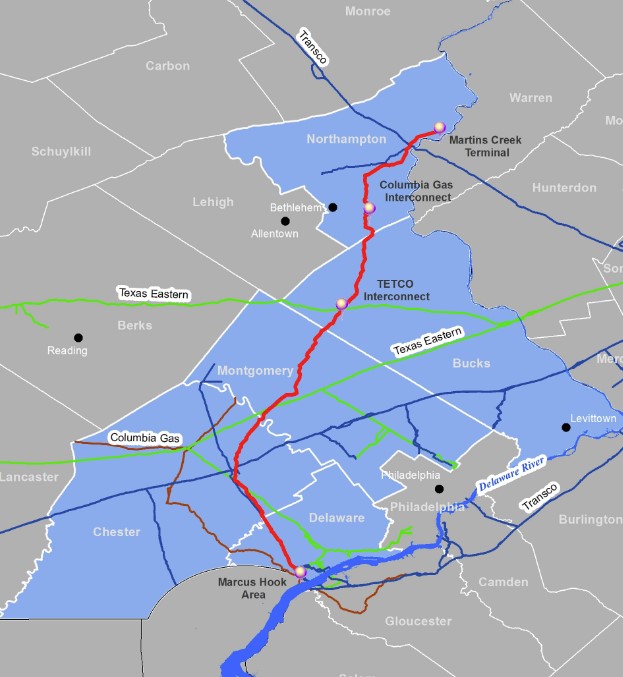
Map of Pipeline

This pipeline impacts property owners in the Northampton County, Bucks County, Montgomery County, Chester County and Delaware County Pennsylvania.  Property Owners are receiving a letter stating:

  • “the ‘Adelphia Gateway Project’ will have minimal impact…..
  • “the right of way/easement agreement for your property may need to be updated…”

Should you just wait and see, or do something now?   Our experience with the Mariner East pipelines  leads us to conclude it is advantageous to negotiate a deal before the company falls back and just condemns the property.

Whenever a pipeline company wants to “update” an easement, this is your opportunity to do two things:  1) update the provisions of the easement that protect you, the property owner, and 2) receive compensation for the changed impact on your property.   Can you do this on your own?  Doing so is somewhat like “brain surgery — self taught.”   Pipeline lawyers handle pipeline issues, divorce lawyers handle….  you get what I mean.  The problem is that most property owners do not know what they do not know.

In most of these cases we are able to structure a fee arrangement that does not involve advancing fees (we get paid from the money we get for you).  We are available at no charge for meetings anywhere in the impacted counties.

The Pipeline has established an information page HERE.


Mariner East 2 Pipeline DEP Settlement

On August 9, 2017 Pennsylvania DEP reached an agreement with Sunoco related to its Mariner East 2 pipeline.  Parties to the agreement included the Clean Air Council, Delaware Riverkeeper Network, and the Mountain Watershed Association, Inc. We have had numerous questions related to this settlement.

The settlement relates to HDD (Horizontal Direct Drilling) activities.  Sunoco will perform a re-evaluation of 41 HDD locations. These include locations along North Pottstown Pike, Swedesboro Rd., Chester Road and Bowtree Drive in Chester County, as well as Gradyville Rd., and Valley Road in Delaware County.  Sunoco will also re-evaluate HDD site which have resulted in inadvertent returns .

A critical element of the settlement is a requirement that Sunoco identify all landowners within 450 feet of any HDD bore. Each of these landowners will have an opportunity to have their water supplies sampled before during and after the start or restart of HDD operations. Each of these landowners will be given 10 days notice before operations begin or read start. Certain other landowners will be given 72 hours notice of the commencement of activities.

A Water Supply Assessment, Preparedness, Prevention and Contingency Plan has been developed and is available for download here.  (It is 630 pages so it takes a while to download)

Tupitza & Kalia monitor activities of pipeline companies across the state and regularly represent landowners when their interests clash with pipeline operators.

Township Sues Sunoco Pipeline,L.P.

2/17/2017

West Goshen Township, in Chester County has filed a complaint with the Public Utilities Commission against Sunoco Pipeline, LP over the Mariner East pipeline.  The suit alleges a breach of an agreement with the township.

The Pipelines

Sunoco Pipeline, L.P.  in recent years repurposed a pipeline that used to deliver gasoline and other refined products from the former Sunoco Refinery in Marcus Hook, Pa (Delaware County) to a distribution point in Washington County, south of Pittsburgh.  That pipeline now flow the other direction, bringing Marcellus Shale products to Marcus Hook.  Sunoco is adding at least one other line called Mariner East II.

The Agreement with West Goshen

West Goshen negotiated a deal with Sunoco to protect the residents of West Goshen.  The deal was extensive and, among other things, required Sunoco to construct two remotely operated valves before the end of 2015.  The valves would permit the isolation of segments of the pipeline in the event of an emergency.  In addition, Sunoco agreed to limit its right to build above-ground facilities without first notifying the Township.  Lawyers from this firm relied on this agreement when negotiating additional protection for our clients.

The Alleged Breach

West Goshen alleges only one of the remotely operated valves has been installed.  In addition, it alleges an above ground valve for Mariner East II is being constructed, without notice, near Boot Road and Greenhill Road.  West Goshen has requested the PUC to issue an Order declaring a violation of the settlement agreement.  This firm is carefully monitoring the case.


Court Gives Property Owners a Win in Oil/Gas

WIN FOR PENNSYLVANIA RESIDENTS – PA SUPREME COURT LANDMARK DECISION OPENS THE DOOR FOR CHALLENGES AGAINST THE OIL/GAS INDUSTRYBy M. Bobbie Kalia, Esq., September 29, 2016

The Pennsylvania Supreme Court yesterday struck down portions of the State’s oil and gas law known as Act 13 in a landmark 4-2 ruling.  This key decision comes pursuant to review of the Commonwealth Court’s 2012 decision in Robinson Township v. Commonwealth, which it largely affirmed.  Three key areas were addressed by the PA Supreme Court yesterday, marking the first significant ruling favoring environmentalists and landowners in a series of Court rulings that have primarily favored the oil and gas industry thus far.

The Supreme Court addressed three areas of the revised state law, Act 13, passed by the legislature in 2012 and signed into law by former Governor Tom Corbett.

  1. Most importantly, the State’s Supreme Court landmark ruling yesterday struck down as unconstitutional the oil and gas industries’ right to uniform zoning restrictions across the state. A lawsuit was initially filed in 2012 challenging the law.  In 2014 by the lower court blocked the provision that granted the State’s utility commission power to review the zoning restrictions and impose penalties against municipalities that attempted to enforce harsher restrictions than those of the State.  In its ruling yesterday, the Supreme Court addressed the power of the Public Utility Commission (PUC) to interfere with right of local government to place harsher zoning restrictions on oil and gas companies.  For the first time, the Court used the Environment Rights Amendment, Article I, Section 27 of the Constitution to support its decision, recognizing the importance of each Pennsylvania resident’s “environmental rights” and their need for protection of these important rights to resources such as clean air and clean water.  The court further concluded that such a role includes the ability to limit oil and gas development as needed to protect these important public natural resources and that it is the obligation of the government to “refrain from unduly infringing upon or violating the right.”  The PUC will no longer have a right to decide whether Act 13 violates local ordinances.  This determination will be left to individual municipalities, which the Court referred to as “trustees of an environmental public trust.”  A major hit to the oil and gas industry, because, until now, the oil and gas industry has used the PUC as blanket authority granting the industry its rights to shield itself from public scrutiny of the industries’ actions.  Again, a long awaited victory for environmentalists and landowners whose properties are impacted by the pipeline, as it marks the first time a Pennsylvania State Court has addressed the PUC’s role or right to interfere with local communities.
  1. The second major impact from the decision, denied the use of eminent domain by oil and gas companies for gas storage facilities, primarily set up underground, stating that although there may be some minimal benefit to the public by these facilities, the benefit is primarily to the oil and gas company. This ruling is significant because it paves the way for Courts to finally address the issue of the validity of the industries right to use eminent domain for oil and gas purposes based upon the idea that it benefits the public.  A hotly debated issue that has been argued by environmentalists and landowners not only since the oil and gas industry came to Pennsylvania, but throughout the country.
  1. Finally, the Court examined the industries’ incomplete disclosure procedures with regards to what is known as the use of the “medical gag rule”. The Court ruled that now oil and gas companies must provide complete disclosure of all chemicals used to produce oil or gas to health care providers; a complete list which could previously only be obtained after the requesting medical provider signed a nondisclosure agreement.  Act 13 requires an oil or gas company release a list of chemicals it uses in the process of producing oil or gas on a website that can be accessed only by medical providers and physicians.  This enables the medical professional to properly treat against exposure or take precautions as needed.  Until the Court’s ruling, oil and gas companies’ disclosure of the chemicals it uses has been grossly incomplete, stating that a full list could only be disclosed to medical providers or physicians if they would sign a nondisclosure agreement for protection of company trade secrets.  The Court ruled that to allow this restriction only used by the oil and gas industry would be unconstitutional and full disclosure is now required.

So what does this decision mean to a homeowner being approached by a pipeline company or facing eminent domain?  The Supreme Court’s decision sets forth a much needed and long awaited victory in the battle against the oil and gas industry in what is known as the “Marcellus Shale Gas Rush.”  It certainly opens a doorway to fight the company threatening to take a landowner’s property for those that are willing to spend the time, money and face the potential risks, for the benefit of a win against the oil and gas industry in the Courts.  However, it is important for a landowner to take into consideration that it is a long, costly fight and the Court’s decision, although unprecedented in its nature, does not ensure a guaranteed win.  Prior to vesting in the decision, a landowner must consider his or her individual resources, whether their family or business will survive such a commitment, what is the ultimate outcome the landowner is looking for and whether the fight is for principal or personal reasons.  Each individual’s case against an oil or gas company is usually different in one way or another and these individual circumstances may plan an important role in the possibility of a successful argument against the company.

If you stand on principal, then fight is the only answer.  There are many organizations working to stop the oil and gas industry from turning Pennsylvania into as a State filled with what the pipeline refers to as “spaghetti cities” due to the multitude of pipelines running through one area; sometimes 4 pipelines deep in an easement space.  Working with an organization can aid a landowner in getting fully informed on pending cases, discussions with State Senators and Representatives and other helpful information when taking on the industry.

If principal is not your main, then it is highly advised that the landowner determine those protections and issues that are of individual concern and consider working with an attorney to ensure those protections and issues are addressed in their individual Permanent Easements.  Many times, an attorney will be able to negotiate all the landowner’s concerns into the easement agreement and increase the compensation guaranteed to the landowner without immediate out of pocket costs incurred to the landowner.   It is important to note that once the compensation has been spent, the protections within the easement agreement will ensure the landowner’s rights are protected in situations such as environmental spills.

Regardless of how Pennsylvania residents choose to approach their issues with the oil and gas industry, one thing is for certain, the Supreme Court’s decision creates an important opening in the law those fighting the oil and gas industry have been long waiting for, making it clear that the war between parties has only just begun.

Group moves to Stop Sunoco Pipeline.

September 26, 2016, Delaware County, PA.   The Middletown (Delaware County, PA) Coalition for Community Safety is presenting an emergency application for an Injunction today to delay the vote by the Township of Middletown, in connection with the granting of easements to Sunoco Pipeline, LP (“SPLP”), for its Mariner East II pipeline.

The group is asking the court to declare Middletown Township Council’s failure to consider independence evidence of the safety of the Mariner East II pipeline, as a violation of the constitutional rights of Township residents and businesses.

The 19-page filing (with 83 pages of exhibits) represents that SPLP:

  1. told the Township Council that its new pipeline would be built 4222 feet away from a school when in fact it is 800 feet from the center of the school, and 650 feet from the playground;
  2. informed Council that has an excellent safety record when in fact publicly available information shows it has the worst safety record in the industry;
  3. fossil informed Council that he has an emergency evacuation plan, when in fact the plan does not provide a reasonable protocol consistent with the potential blast wave from an odorless, tasteless product being transported in the pipeline;
  4. falsely informed Council it has an emergency evacuation plan consistent with public safety when in fact it’s plan does not account for the fact that the liquids and gas that escape have no load or are invisible in our flammable with the smallest heat or electrical source and that the blast wave pack so much energy that catastrophic loss of life and property are inevitable;

The Delaware County Court will consider the matter today, prior to tonight’s township meeting.

Todays filings:  Petition   Exhibits 


EPA Questions Atlantic Sunrise Pipeline


In July, 2016, the United States Environmental Protection Agency issued a four-page letter to FERC (the Federal Energy Regulation Commission), raising questions about Transco’s Atlantic Sunrise Pipeline, proposed to be built through Pennsylvania.

The 30-inch pipeline is designed to carry natural gas from Marcellus Shale production areas to Transco’s Pooling Point in Choctaw County, Alabama. For about 28% of its 197.7 PA miles, the pipeline will be co-located within, or adjacent to existing pipelines, and or electrical transmission utility rights-of-way.

Transco’s Draft Environmental Impact Statement (DEIS) created concern to the EPA, because it put forward Transco’s preferred proposal for pipe location, and did not fully study alternatives, including one alternative by which expansion of the existing PennEast Pipeline by 80 miles, could entirely eliminate the need for the Atlantic Sunrise Pipeline.

EPA expressed concern about direct, secondary and cumulative impacts to water resources, including groundwater, wetlands and waterways, and recommended full assessment of impacts to these types of resources. In addition, EPA noted there would be “large impacts” to terrestrial resources including forests and the habitats of forest interior dwelling species.

EPA noted that there is a complex infrastructure, including natural gas wells, gathering lines and other natural gas transmission facilities, that all interact with the proposed Atlantic Sunrise Pipeline. EPA recommended that FERC should actively “unravel and describe the highly complicated, interrelated network of pipelines.”

EPA summarized its review of the Draft Environmental Impact Statement, by concluding the statement had “Insufficient Information.”

DEP Notice to Sunoco – Mariner East II Pipeline

DEP Issues Technical Deficiency Notice for Chester County Chapter 105 Application of Sunoco Pipeline for Mariner East II.

On September 6, 2016, the PA DEP issued a Technical Deficiency Notice to Sunoco Pipeline, L.P. regarding its Mariner East II Pipeline in Chester County, PA. There will be similar notices for every county in which the Mariner East II Pipeline is to be constructed. The notice related to Sunoco’s application for permits under Chapter 105, Dam Safety and Waterway Management Regulations.

Chapter 105, in non-technical terms, governs the crossing of streams, wetlands and other waterways. It also governs erosion and sedimentation controls.

A Sampling of the Deficiencies

The Technical Deficiency Notice comprises 21 pages of single spaced comments. Here is a sample of some of the deficiencies:

  • provide details of each stream and wetland crossing, together with associated erosion and sedimentation controls;
  • provide site plans depicting work within a floodway or floodplain;
  • provide detail on any proposed cathodic protection;
  • identify all locations for horizontal direct drilling work, and all temporary crossings of wetlands associated with this work;
  • provide actual floodway boundaries as opposed to assuming floodway’s are within 50 feet of stream;
  • revised plans to delete stockpiling of soil in wetlands;

Safety Issues-Private Wells

The types of comments listed above are normally associated with a Chapter 105 application.  A significant requirement is found on page 17 of the report: “the application will need a comprehensive Preparedness Prevention Contingency Plan (PPC) combined with the Inadvertent Release Plan (IRP). The plan needs to include downstream notification lists of public and other water intakes and public and private water wells along the ROW, noting those water users along areas where HDD will be utilized.”

The report notes that Sunoco talked about wanting to protect private water supplies but did not include a formal plan doing so. The DEP suggested four possible options:

  • map where the pipeline crisis sensitive geology and aquifers;
  • locate and identify contact information for drinking water wells in the vicinity of the pipeline;
  • acknowledge that within one half mile wells are potentially vulnerable over a long period of time and within 400 feet wells are vulnerable in a short time after he release; and
  • water quality sampling and analysis of nearby wells could monitor quality impacts.

Summary 

Sunoco Pipeline, L.P. has a lot of additional work to complete before PA DEP will issue its permits.  The requirements related to neighboring wells may significantly increase their burden, but will help to speed emergency notification to neighboring well owners.

Special Alert- Property Owners Signing Pipeline Easements

Our firm represents many landowners who have had to deal with new pipeline easements.  Whether it is the Sunoco Mariner East series of lines, the Columbia Lines, Eastern Shore Natural Gas, the Williams Atlantic Sunrise, Constitution Pipeline or any other pipeline, there are lingering issues you need to consider:

Sooner or later, most of us will sell all the real estate we own.  What would you think if I told you that you would be in default under the contract, the minute you signed it?

Let’s take this apart and discuss residential real estate first.  Most homes are sold with contracts using the Pennsylvania Association of Realtors® form.  That form requires a Seller to deliver a special warranty deed at closing.  A special warranty deed is one in which you, the seller, warrant that you have not done anything to diminish the absolute title to the property received by you.  Guess what?  The execution of an easement for a pipeline diminishes the title to your property.

Why is this important?  Let me give you a very realistic example.  You are at closing; the buyer wants money, because they saw something during the walk through.  You say no.  They say ‘give me a $5000 credit or I will not buy the house.’  You say, ‘you are in default and I will take your deposit.’  They say, ‘OK deliver to me a special warranty deed, and I will immediately sue you for the money you were paid by the pipeline company.”   Oops, they have you.

What is the solution?  First, prior to signing a contract, make reference to the pipeline easement in your sellers’ disclosure. Next, you need to modify the agreement of sale. The reason is you need to be obligated to deliver a deed of special warranty, excepting the pipeline easement you have executed. Finally, at the time of closing, you need to modify the warranty provision in the deed to exclude from the warranty anything related to the pipeline easement.

If you signed a pipeline easement, print this page out and put it where you can find it when you want to sell.

If you have a commercial property, the issue may be even more dangerous.  That is because buyers often spend considerable money on due diligence.  If a buyer has spent $20,000 before they learn you cannot deliver a special warranty deed, you will not have a pleasant day.